Tuesday June 2 2015
Collaborative process begins for renewal of federal license for the Weber hydroelectric project
- Filed Under:
- News Release
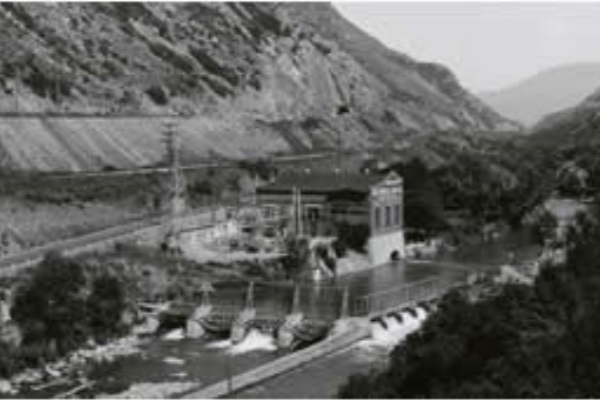
SALT LAKE CITY — With renewal of the federal license for the Weber hydroelectric project due in 2020, Rocky Mountain Power has initiated a collaborative process to involve stakeholders and the public in the development of terms for the new license.
The small hydroelectric project is located on the Weber River near the mouth of Weber Canyon east of Ogden, Utah, between the eastbound and westbound lanes of U.S. Interstate 84. Licenses for hydroelectric projects are issued by the Federal Energy Regulatory Commission (FERC). Rocky Mountain Power submitted its notice of intent to the commission May 29.
“The notice also informs the commission that the company requests the alternative licensing process,” said Eve Davies, principal scientist for the utility and project manager for the license renewal. “The alternative process is more collaborative, will save time and effort for all parties and seeks compromise rather than litigation concerning any contested issues.”
Along with the notice of intent to renew its license, Rocky Mountain Power submitted to the FERC a preliminary application document containing detailed project information. In it, the utility notes two preliminary meetings it conducted with interested parties on March 5 and April 28 to solicit their input on the preliminary application and discuss requirements for the alternative license process.
“We have excellent working relationships with the state and federal agencies involved in the operation of the Weber project,” Davies said. “As well, these relationships extend to organizations and individuals interested in fishing, recreation and wildlife habitat associated with the company’s hydroelectric projects. We value their contributions in this process, together with other public comments we expect to receive in the course of completing the renewal of Weber’s license.”
Rocky Mountain Power is not proposing any additions to the project or major changes in operations. The next steps involve the FERC’s approval of the alternative process, which may take about 60 days. Assuming the commission approves, public meetings will be scheduled by the utility with a 30-day notice of time and place.
Meantime, interested parties may review the utility’s preliminary application document via the company’s website:
http://www.pacificorp.com/es/hydro/hl/weber.html
# # #
About the Weber hydroelectric project
The plant was completed in 1910 by Utah Light and Railway Company, a predecessor of Rocky Mountain Power, which acquired the railway company in 1944. It is located on the Weber River near the mouth of Weber Canyon east of Ogden, Utah, between the eastbound and westbound lanes of U.S. Interstate 84.
Weber can generate 3.85 megawatts of electricity at full capability, which is equivalent to the needs of about 1,900 typical homes today. The original federal license was granted January 1, 1938. The current license was issued June 28, 1990 and expires on June 28, 2020.
The Weber project includes a reinforced concrete diversion dam 27 feet high and 79 feet long, upstream from the power house. A 6-foot diameter pipeline 9,107 feet long conveys water underground to the power house to turn the hydroelectric turbine and generator. The power plant generates only as water is available in Weber River. The water is then returned to the Weber River below the power house. The total project area comprises 8.4 acres and the diversion dam contains only about 42 acre-feet of water.
The Weber project is on the National Register of Historic Places because of its significance to the development of electric utilities in Utah.
During the early days of electric service in Utah between about 1880 and 1912, many small companies built hydroelectric projects on the rivers and creeks of the Wasatch Front to power mining operations, city street lighting and electric street cars. Because expanding electric systems was so expensive, many of these small companies had financial trouble, and were consolidated into larger firms. The Weber project, begun in 1909, was built at the direction of E.H. Harriman, president of Union Pacific Railroad, after he acquired Utah Light and Railway Company.
The construction of the Weber project helped spur these consolidating utilities to begin connecting their hydroelectric projects and coordinating operations. This greatly increased the reliability of electric service at minimal cost, because most of the transmission lines were already in place. The modern integrated electric utility was well underway along Utah’s Wasatch Front by 1915.
Several of these early hydroelectric projects are still operating today, some after more than a century of service. They continue to provide valuable, low-cost electricity to customers from a renewable resource.
About Rocky Mountain Power
Rocky Mountain Power is one of the lowest-cost electricity providers in the U.S., serving 1 million customers in Utah, Wyoming and Idaho. The utility has a diverse generation mix, utilizing hydroelectric, coal, natural gas, geothermal and wind sources. Rocky Mountain Power is a division of PacifiCorp, which through the Pacific Power division, also provides electric service to customers in Oregon, Washington and northern California.
For information, contact:
David Eskelsen, 801-220-2447